

Sustainability · 2025
In this section56 topics
- Sustainability Policy2 items
- Sustainability Goals & UN SDGs3 items
- Policy Review3 items
- Business Value Chain1 item
- Stakeholder Analysis2 items
- Environmental Policy & Guidelines3 items
- Environmental Policy Review3 items
- Energy — Plan & Guidelines2 items
- Energy — Electricity Consumption2 items
- Energy — Fuel Consumption3 items
- Energy — Targets2 items
- Energy — Performance & Outcomes2 items
- Water — Plan & Guidelines2 items
- Water — Withdrawal, Discharge & Consumption1 item
- Water — Targets2 items
- Water — Performance & Outcomes2 items
- Waste — Plan & Guidelines2 items
- Waste — Generation, Disposal & Recycling1 item
- Waste — Targets2 items
- Waste — Performance & Outcomes2 items
- GHG — Plan & Guidelines2 items
- GHG — Emissions1 item
- GHG — Emissions Verification1 item
- GHG — Principles & Standards1 item
- GHG — Targets1 item
- GHG Targets — Net Zero1 item
- GHG Targets — Carbon Neutrality1 item
- GHG — Performance & Outcomes2 items
- Environmental Legal Incidents2 items
- Other Environmental Management1 item
- Social Sustainability — Overview1 item
- Social Policy & Guidelines3 items
- Social Policy Review2 items
- Social — Principles & Standards Practised1 item
- Human Rights Due Diligence2 items
- Employee Management — Overview1 item
- Employees — Plan & Guidelines3 items
- Employees — Workforce1 item
- Employees — Remuneration & Provident Fund2 items
- Employees — Training & Development2 items
- Employees — Occupational Health & Safety2 items
- Employees — Labour Relations2 items
- Employees — Employee Representation3 items
- Employees — Targets2 items
- Employees — Performance & Outcomes2 items
- Customer Management — Overview1 item
- Customers — Plan & Guidelines3 items
- Customers — Satisfaction Results1 item
- Customers — Targets3 items
- Customers — Performance & Outcomes2 items
- Community & Social — Overview1 item
- Community & Social — Plan & Guidelines3 items
- Community & Social — Targets2 items
- Community & Social — Performance & Outcomes2 items
- Law Violation Incidents1 item
- Law Violations — Case Detail & Corrective Measures1 item
Sustainability Policy
Has a Sustainability Policy
Yes
Policy Description
The automotive parts manufacturing business is a major driver of the country's industrial sector. Currently, the automotive industry is undergoing a technological transition from internal combustion engines to electric vehicle technology. To achieve sustainable development, the company conducts its business with sustainability in mind, considering the economic, social, and environmental impacts of its activities. We are committed to being a good corporate citizen, fully complying with relevant laws and regulations. The company is committed to developing, promoting, and enhancing the quality of life for society and communities, especially neighboring communities, in parallel with the company's growth.
Sustainability Goals & UN SDGs
Has Sustainability Goals
Yes
Goals Description
The company has therefore analyzed and reviewed important issues to formulate strategies in line with medium-term strategic plan (2020-2025) and respond to sustainable development, with the following objectives:
Indicators and Goals for the Economy: Smart Factory
Increase production and production innovation capabilities and technology, connect production with Smart Factory, develop information technology systems, 100% target according to the product responsibility plan, including customer satisfaction assessment, customer complaint management on quality, and on-time delivery.
Indicators Indicators and Goals for Personnel Development: Smart People
Human Resource Competency Development, Teamwork Building, and Organizational Commitment
Indicators and Goals for Society, Community and Environment: Group up Together
Goodness Sharing, Participation, Occupational Health and Safety, and Environmental Management
UN Sustainable Development Goals
| SDG Goal |
|---|
| Goal 4 Quality Education |
| Goal 4 Quality Education |
| Goal 4 Quality Education |
| Goal 4 Quality Education |
| Goal 4 Quality Education |
| Goal 5 Gender Equality |
| Goal 5 Gender Equality |
| Goal 5 Gender Equality |
| Goal 5 Gender Equality |
| Goal 5 Gender Equality |
| Goal 8 Decent Work and Economic Growth |
| Goal 8 Decent Work and Economic Growth |
| Goal 8 Decent Work and Economic Growth |
| Goal 8 Decent Work and Economic Growth |
| Goal 8 Decent Work and Economic Growth |
| Goal 9 Industry, Innovation and Infrastructure |
| Goal 9 Industry, Innovation and Infrastructure |
| Goal 9 Industry, Innovation and Infrastructure |
| Goal 9 Industry, Innovation and Infrastructure |
| Goal 9 Industry, Innovation and Infrastructure |
| Goal 12 Responsible Consumption and Production |
| Goal 12 Responsible Consumption and Production |
| Goal 12 Responsible Consumption and Production |
| Goal 12 Responsible Consumption and Production |
| Goal 12 Responsible Consumption and Production |
| Goal 16 Peace, Justice and Strong Institutions |
| Goal 16 Peace, Justice and Strong Institutions |
| Goal 16 Peace, Justice and Strong Institutions |
| Goal 16 Peace, Justice and Strong Institutions |
| Goal 16 Peace, Justice and Strong Institutions |
Policy Review
Policy Reviewed This Year
Yes
Policy Changed This Year
Yes
Review Details
Sustainability Policy
Strategic Policy Alignment The Company has enhanced its Sustainability Policy to align with its core corporate strategy, ensuring a unified direction across business operations, social responsibility, and environmental stewardship. The updated Environmental Policy focuses on the following key pillars:
Commitment to Carbon Neutrality: The Company aims to achieve Carbon Neutrality by reducing annual greenhouse gas (GHG) emissions by 5% relative to the 2020 base year, targeting a cumulative reduction of 30% by 2030.
Global Standards & Certification: The Company targets to obtain the Carbon Footprint for Organization (CFO) certification and/or the ISO 14064 standard (International Standard for GHG quantification, reporting, and verification) by 2026.
Climate Resilience: Prioritizing Climate Change Adaptation to mitigate operational risks and enhance long-term environmental sustainability.
Business Value Chain
Value Chain Description
The Company is committed to managing its supply chain to be efficient and able to support continuous improvement in line with the Company's growth strategy. This ensures the Company can deliver quality products and services to customers on time. In addition, the Company also promotes green procurement or environmentally friendly procurement in addition to general procurement regulations. This builds confidence and acceptance from customers as well as creates shared value for consumers and society. To achieve transparency, efficiency, and accountability in its operations, and to build confidence among all stakeholders throughout the supply chain, the Company has assigned the Sustainability and Corporate Governance Committee to establish policies, oversee, and monitor operations to comply with relevant laws, rules, regulations, and standards. This fosters understanding and collaboration in developing procurement processes in accordance with the Company's strategies.
To create a system understanding, the Company has prepared a diagram of activities in the value chain as follows:
Stakeholder Analysis
Introduction
To ensure successful business operations that align with the company's mission and its commitment to stakeholders, in addition to listening to feedback and suggestions as opportunities arise, the company has implemented mechanisms, communication channels, and methods for responding to stakeholder expectations. These are applied to sustainability operations, including improvements to the company's disclosure. In the past year, the company has carried out activities to connect with stakeholders and taken actions to meet the expectations of each group as follows:
Stakeholder Analysis
| Stakeholder Type | Stakeholders | Stakeholder Expectations | Response to Expectations | Communication Activities |
|---|---|---|---|---|
| Internal stakeholders | 2921 · Description: Employees | - Appropriate salary increases
- Provision of appropriate benefits
- Occupational safety
Reduce health risk factors
- Pleasant working environment
Equality and opportunities for advancement
- Training and development plans
- Well-being and good food | - Executive Meet & Greet/Monthly Meeting
- Welfare Committee in the Workplace
- Safety News
- Annual Training and Development Plan, Orientation
- Employee Happiness Survey
- Employee Feedback and Grievance Mechanism | 2945 · Description: Complaint Reception · 2946 · Description: Employee Engagement Survey · 2947 · Description: Satisfaction Survey · 2948 · Description: Training / Seminar |
| External stakeholders | 2923 · Description: Customers | - Customer Relationship Management
- Product Liability
- Product Quality
- On-Time Delivery
- Confidentiality of Information | Customer satisfaction score of 91.89%, Customer complaints were addressed, No complaints about privacy breaches were found | 2941 · Description: Online Communication · 2943 · Description: External Meeting · 2947 · Description: Satisfaction Survey |
| External stakeholders | 2899 · Description: Suppliers | - Receive accurate information promptly, within the specified timeframe.
- Adhere to fair payment terms and conditions.
- Fair and transparent price competition. | - On-time raw material delivery rate of 90.62%.
- Reduction in the rate of substandard raw materials rare if 0.70% | 2938 · Description: Visit |
| External stakeholders | 2904 · Description: Investors or investment institutions · 2913 · Description: Shareholders | - Operating Results / Profit
- Return on Investment
- Good Corporate Governance
- Stable and Sustainable Business Growth
- Accurate, Complete, and Up-to-date Company Information
- Effective Monitoring and Control System | - The Company has consistently paid dividends over the past 10 years, with a payout ratio exceeding 50% of the separate financial statements.
- The shareholder meeting management assessment resulted in a score of 95%.
CG Score = 5 (Excellent)
| 2939 · Description: Press Release · 2944 · Description: Annual General Meeting (AGM) |
| External stakeholders | 2902 · Description: Community · 2931 · Description: Government agencies and Regulators | - Being a good neighbor and supporting community activities
- Not causing negative impacts on the community and society
- Having transparency in operations
- Upholding human rights and opposing corruption | - Recognized by the community and society through various activities.
- No complaints from the community and society.
- Continuous support to the community and local hospitals. | 2940 · Description: Social Event · 2945 · Description: Complaint Reception · 2949 · Other name: Accepting interns through a dual vocational training system · Description: Others |
Environmental Policy & Guidelines
Has an Environmental Policy
Yes
Policy Description
Environmental and Energy Conservation Policy
P.C.S. Machine Group Holding Public Company Limited
P.C.S. Machine Group Holding Public Company Limited, a leader in the manufacturing of metal automotive parts—specializing in die-casting, hot stamping, and high-precision machining for engines, transmissions, chassis, axles, and fuel injection systems—is steadfastly committed to operating with environmental responsibility at its core.
The Company strictly adheres to environmental laws and regulations while proactively managing resources and energy efficiency to minimize pollution, waste, and ecological impact. Notably, we prioritize the mitigation of greenhouse gas (GHG) emissions in response to global climate change, aiming for Carbon Neutrality by 2030. We further commit to fostering biodiversity and creating shared value for our communities and stakeholders.
To achieve these objectives, the Company hereby establishes the following Environmental and Energy Conservation Policy:
Sustainable Resource & Waste Management: Reduce waste and optimize energy and resource utilization, with a target reduction of 5% compared to 2024.
Renewable Energy Promotion: Develop and enhance renewable energy initiatives, targeting a 5% increase in renewable energy of the year 2024.
Environmental Risk Management: Conduct comprehensive environmental risk assessments to proactively prevent, mitigate, and improve environmental quality and safety standards.
Pathway to Carbon Neutrality: Reduce annual GHG emissions by 5% against the 2020 base year, achieving a cumulative reduction of 30% by 2030.
Regulatory Compliance & Stakeholder Trust: Ensure full compliance with all relevant environmental laws and regulations, maintaining a "Zero Complaint" status from customers, communities, and governmental agencies.
International Standards & Certification: Aim to achieve Carbon Footprint for Organization (CFO) and ISO 14064 certifications by 2026, ensuring international-grade GHG quantification and reporting while enhancing climate resilience.
Community Engagement & Biodiversity: Collaborate with local communities on environmental projects to promote biodiversity and foster sustainable co-development.
Environmental Guidelines
| Guideline |
|---|
| Electricity Management |
| Fuel Management |
| Renewable/Clean Energy Management |
| Water Management |
| Waste Management |
| Biodiversity Management |
| Greenhouse Gas and Climate Change Management |
| Air Quality Management |
| Noise Pollution Management |
Environmental Policy Review
Policy Reviewed This Year
Yes
Review Details
Pathway to Carbon Neutrality: Reduce annual GHG emissions by 5% against the 2020 base year, achieving a cumulative reduction of 30% by 2030.
Regulatory Compliance & Stakeholder Trust: Ensure full compliance with all relevant environmental laws and regulations, maintaining a "Zero Complaint" status from customers, communities, and governmental agencies.
International Standards & Certification: Aim to achieve Carbon Footprint for Organization (CFO) and ISO 14064 certifications by 2026, ensuring international-grade GHG quantification and reporting while enhancing climate resilience.
Policies & Guidelines Changed
| Change |
|---|
| Electricity Management |
| Fuel Management |
| Renewable/Clean Energy Management |
| Water Management |
| Waste Management |
| Biodiversity Management |
| Greenhouse Gas and Climate Change Management |
| Air Quality Management |
| Noise Pollution Management |
Energy — Plan & Guidelines
Has an Energy Management Plan
Yes
Plan Description
Improve annual energy consumption reduction targets from the original target of 5% reduction from the previous year and promote the search for energy conservation activities and projects. Increase production process efficiency to reduce energy consumption within the company.
Energy — Electricity Consumption
Introduction
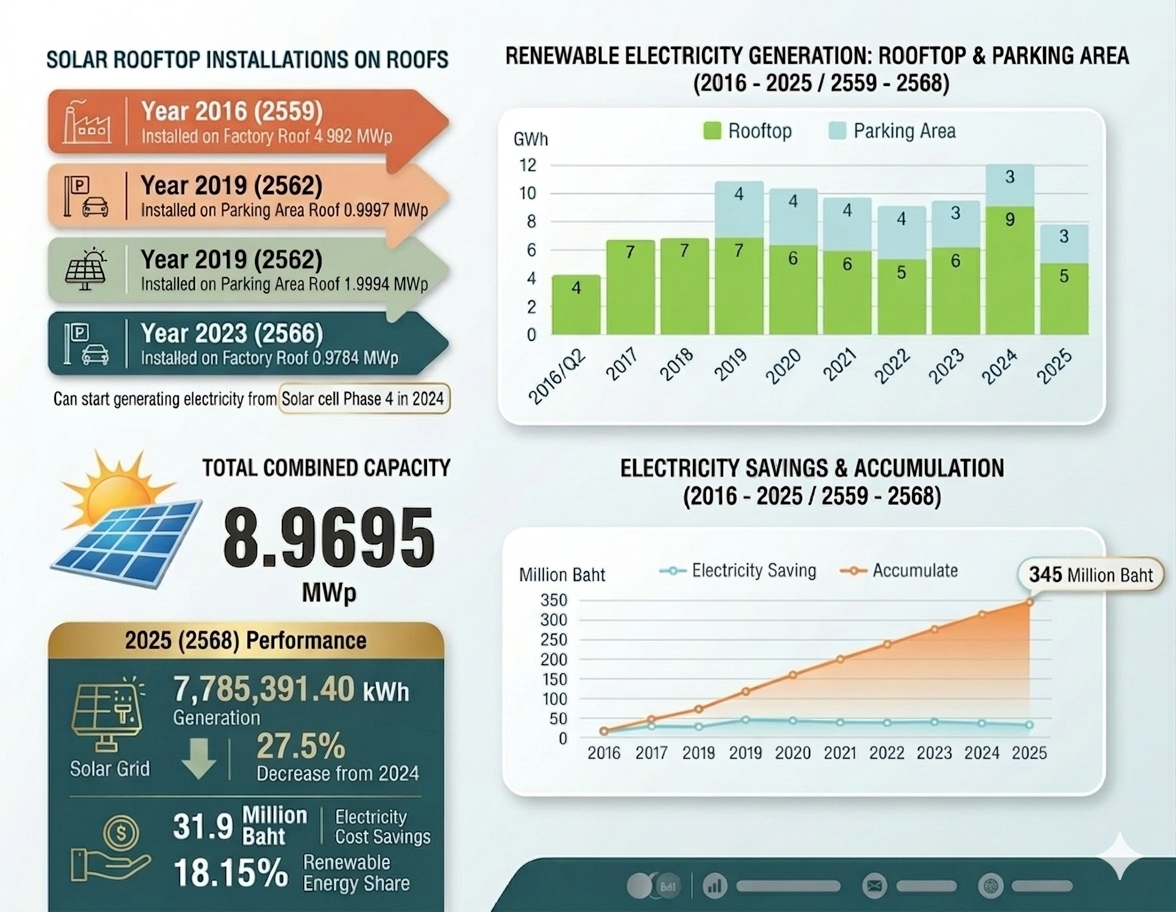
Solar Rooftop Installation Project
Significance & Objectives The Company is committed to transitioning toward clean energy by integrating renewable resources into our production processes. This represents a pivotal step in driving economic development in tandem with leveraging technology to optimize energy efficiency and reduce operational costs, ultimately fostering long-term value and sustainability for the organization.
Operational Performance To date, the Company’s total installed solar power capacity stands at 8.9695 MWp, with a generating potential of approximately 12 million kWh per year.
2025 Performance: Total solar energy generation reached 7,785,391.40 kWh. Despite a 27.5% decrease in production compared to 2024, the initiative successfully reduced annual electricity expenses by THB 31.9 million.
Future Roadmap: In 2025, the Company plans to apply for renewable energy generation certification for the newly completed installations. This will enable the registration and trade of Renewable Energy Certificates (RECs), a process that is currently underway. Significance & Objectives The Company is committed to transitioning toward clean energy by integrating renewable resources into our production processes. This represents a pivotal step in driving economic development in tandem with leveraging technology to optimize energy efficiency and reduce operational costs, ultimately fostering long-term value and sustainability for the organization.Operational Performance To date, the Company’s total installed solar power capacity stands at 8.9695 MWp, with a generating potential of approximately 12 million kWh per year.
2025 Performance: Total solar energy generation reached 7,779,449.10 kWh. Despite a 17.53% decrease in production compared to 2024, the initiative successfully reduced annual electricity expenses by THB 31.9 million.
Future Roadmap: In 2025, the Company plans to apply for renewable energy generation certification for the newly completed installations. This will enable the registration and trade of Renewable Energy Certificates (RECs), a process that is currently underway.
Electricity Consumption
| Metric | Current Year | Previous Year | Two Years Ago |
|---|---|---|---|
| Total electricity consumption within the organization (Kilowatt-Hours) | 42,793,488.95 | 43,537,023.46 | 45,273,428.33 |
| Electricity purchased for consumption from non-renewable energy sources (Kilowatt-Hours) | 35,008,097.55 | 32,797,567.41 | 35,839,552.83 |
| Electricity purchased or generated for consumption from renewable energy sources (Kilowatt-Hours) | 7,785,391.4 | 10,739,456.05 | 9,433,875.5 |
Energy — Fuel Consumption
Introduction
English Translation (for Annual Report)
Vehicle Fleet and Logistics Management Performance 2025
In 2025, P.C.S. Machine Group Holding Public Company Limited achieved significant milestones in elevating operational efficiency through a comprehensive optimization of its vehicle fleet and logistics network. The details of these initiatives are as follows:
Fleet Management:The Company successfully implemented a strategic vehicle allocation plan for executives and employees, ensuring that vehicle use is aligned strictly with core corporate objectives (fit-for-purpose). This measure enhances operational agility, tightens cost control, and reduces greenhouse gas emissions associated with unnecessary vehicle use.
Logistics & Supply Chain Transformation:To transition toward Green Logistics, the Company underwent a profound transformation of its product distribution network, focusing on two main pillars:
Implementation of the Milk Run System: The Company integrated a Milk Run (round-robin) system into its distribution process. This has significantly optimized route planning, maximized truckload efficiency per trip, and drastically reduced empty vehicle mileage.
Elevating Transportation Service Standards: The Company has selected high-standard, professional external transportation service providers with modernized and energy-efficient fleet management. This strategic partnership enhances transportation efficiency through the utilization of GPS systems, effectively mitigates operational risks, and substantially decrease the environmental impact of our logistics network.
Fuel Consumption
| Metric | Current Year | Previous Year | Two Years Ago |
|---|---|---|---|
| Crude oil (Barrels) | 0 | 0 | 0 |
| Coal (Metric tonnes) | 0 | 0 | 0 |
| Jet fuel (Litres) | 0 | 0 | 0 |
| Diesel (Litres) | 44,382.51 | 48,085.66 | 36,825.02 |
| Gasoline (Litres) | 3,888.49 | 8,559.63 | 13,289.43 |
| Fuel oil (Litres) | 0 | 0 | 0 |
| Natural gas (Standard cubic feet) | 0 | 0 | 0 |
| LPG (Kilograms) | 2,426,820 | 2,678,949 | 2,683,323 |
| Steam (Metric tonnes) | 0 | 0 | 0 |
Other Fuels
| Fuel | Unit |
|---|---|
| Gasohol 91, 95, E20 | 1673 · Description: Litres |
Energy — Targets
Has Set Targets
Yes
Targets
| Target | Base Year | Base Year Value | Target Year | Target Year Value | Target Change (%) | Unit |
|---|---|---|---|---|---|---|
| Reduction of electricity purchased for consumption | 2,024 | 43,537,023.46 | 2,025 | 41,360,172.29 | 5 | Kilowatt-hour |
Energy — Performance & Outcomes
Has Performance Results
Yes
Performance Description
Energy Consumption and Conservation Performance 2025
In 2025, the Company monitored and analyzed energy consumption to enhance resource management efficiency. The total energy usage figures are as follows:
Electricity Consumption: 42,793,488.95 kWh
Energy Conservation and Efficiency Projects: To align with the strategic goal of a 5% reduction in resource consumption, the Company implemented several energy-saving initiatives:
Melting Furnace Overhaul Project: To improve thermal efficiency and reduce energy loss during the casting process. reduced in LPG consumption of 72,002.4 kg/year.
Air Conditioning Optimization: Regular cleaning and maintenance of HVAC systems to maximize cooling efficiency and reduced electrical load.Reduced electricity consumption by 33,204.82 kWh/year.
Holiday Compressed Air Management: Shutting down four 200 HP air compressors during non-production periods to eliminate unnecessary energy idling. Reduced electricity consumption by 311,296 kWh/year.
Pneumatic System Leakage Repair (Factory 1): Rectifying air leaks in the production line to optimize system pressure and minimize compressor energy consumption. Reduced electricity consumption by 210,174.72 kWh/year.
Water — Plan & Guidelines
Has a Water Management Plan
Yes
Plan Description
The company is steadfast in its commitment to optimizing water management efficiency, prioritizing conservation and resource-efficient processes throughout its operations.
Strategic Water Self-Sufficiency Model In collaboration with P.C.S. Estate Industrial Estate, the Company has implemented a localized and integrated water management model, aimed at achieving a sustainable and water-self-sufficient organizational standard:
100% Water Self-Sufficiency Strategy: The Company does not utilize communal tap water. All water resources are secured and produced independently within the P.C.S. Estate Industrial Estate. Raw water for water production is derived from three primary integrated sources:
Integrated Rainwater Harvesting: Efficient collection and storage of rainwater in the estate’s surface water reservoirs.
Process Water Reuse (Zero Liquid Discharge from Production): Reclaiming process water that did not pass the membrane filtration stage (RO system) and unfiltered tap water from drinking water production processes, returning it to the surface reservoirs.
Advanced Water Recycling & Reuse: Collecting all fully treated and compliant process wastewater, integrating it into the surface reservoirs for internal reuse.
Operation based on Zero Discharge & Shared Value with Community This self-sufficiency model delivered value not only to the organization but also proactively mitigates environmental impact and fosters shared value for the surrounding communities:
Zero Discharge Policy: The Company has strictly enforced a zero-discharge policy, ensuring that no industrial wastewater is released from the plant into external waterways or public water bodies.
Community Partnership: Water Management in Agricultural Areas: The Company and P.C.S. Estate operate a collaborative water management program with surrounding agricultural communities, facilitating effective flood and drought management:
Flood Season: Communities are permitted to discharge excess flood water from agricultural land into the industrial estate’s surface water reservoirs.
Harvest Season: Communities can also drain water from rice fields to prepare for harvest into the estate’s reservoirs, thus protecting agricultural produce from water damage and ensuring a timely harvest.
Water — Withdrawal, Discharge & Consumption
Water Withdrawal, Discharge & Consumption
| Metric | Current Year | Previous Year | Two Years Ago |
|---|---|---|---|
| Total water withdrawal (Cubic meters) | 276,932 | 314,905 | 283,951 |
| Total water withdrawal by third-party water (Cubic meters) | 276,932 | 314,905 | 283,951 |
| Total water withdrawal by surface water (Cubic meters) | 0 | 0 | 0 |
| Total water withdrawal by groundwater (Cubic meters) | 0 | 0 | 0 |
| Total water withdrawal by seawater (Cubic meters) | 0 | 0 | 0 |
| Total water withdrawal by produced water (Cubic meters) | 0 | 0 | 0 |
| Percentage of wastewater treated before discharge (%) | 100 | 100 | 100 |
| Total water discharge (Cubic meters) | 221,545.6 | 251,926 | 227,161 |
| Total water discharge to third-party water (Cubic meters) | 221,545.6 | 251,926 | 227,161 |
| Total water discharge to surface water (Cubic meters) | 0 | 0 | 0 |
| Total water discharge to groundwater (Cubic meters) | 0 | 0 | 0 |
| Total water discharge to seawater (Cubic meters) | 0 | 0 | 0 |
| Total water consumption (Cubic meters) | 55,386.4 | 62,979 | 56,790 |
| Recycled water (Cubic meters) | 443,090 | 503,830 | 45,432 |
Water — Targets
Has Set Targets
Yes
Targets
| Target | Base Year | Base Year Value | Target Year | Target Change (%) | Unit |
|---|---|---|---|---|---|
| Reduction of water withdrawal | 2,024 | 314,905 | 2,025 | 5 | Cubic meters |
Water — Performance & Outcomes
Has Performance Results
Yes
Performance Description
In 2025, P.C.S. Machine Group Holding has continuously elevated its water management efficiency, achieving tangible outcomes as follows:
1. Total Water Consumption Statistics & Sourcing The Company has successfully achieved a significant reduction in total water consumption. The actual performance data is detailed below:
Category | Base Year (2024) | Current Year (2025) | Reduction | Percentage Reduction (%) |
Total Water Consumption | 314,905.00 | 276,932.00 | 37,973.00 | 12.06% |
The actual percentage reduction of 12.06% against the previous base year demonstrates tangible success in maximizing the value of the shared water resources and mitigating pressure on natural water bodies. The actual water consumption proportion.
Water Conservation Initiatives & Key Success Factors The Company has continuously implemented several water conservation measures to optimize water use efficiency and reduce resource loss, including:
Retrofitting & Maintenance: Upgrading internal tap water and sanitary ware equipment to modern, water-saving models with higher efficiency, directly reducing water consumption levels.
Awareness Campaigning: Implementing continuous water conservation campaigns to foster awareness and understanding among employees at all levels on the importance of maximizing water value.
Waste — Plan & Guidelines
Has a Waste Management Plan
Yes
Plan Description
The company places great importance on waste management by establishing clear policies and quantitative targets for waste reduction. The company aims to reduce the amount of waste disposed of/treated in 2025 by 5% from 2024.
Waste — Generation, Disposal & Recycling
Waste Generation, Disposal & Recycling
| Metric | Current Year | Previous Year | Two Years Ago |
|---|---|---|---|
| Total waste generated (Kilograms) | 2,530,718 | 3,872,119 | 2,885,560 |
| Non-hazardous waste (Kilograms) | 1,940,998 | 2,569,114 | 2,103,466 |
| Non-hazardous waste - Landfilling (Kilograms) | 181,740 | 35,760 | 68,210 |
| Non-hazardous waste - Incineration (with energy recovery) (Kilograms) | 0 | 0 | 0 |
| Non-hazardous waste - Incineration (without energy recovery) (Kilograms) | 103,420 | 249,662 | 179,020 |
| Non-hazardous waste - Other disposal operations (Kilograms) | 1,655,838 | 2,283,692 | 1,856,236 |
| Hazardous waste (Kilograms) | 589,720 | 1,303,005 | 782,094 |
| Hazardous waste - Landfilling (Kilograms) | 0 | 0 | 0 |
| Hazardous waste - Incineration (with energy recovery) (Kilograms) | 435,340 | 831,790 | 525,570 |
| Hazardous waste - Incineration (without energy recovery) (Kilograms) | 0 | 7,100 | 2,500 |
| Hazardous waste - Other disposal operations (Kilograms) | 154,380 | 464,115 | 254,024 |
| Total reused/recycled waste (Kilograms) | 1,802,420 | 2,798,107 | 2,148,750 |
| Reused/Recycled non-hazardous waste (Kilograms) | 1,655,840 | 2,283,692 | 1,856,236 |
| Reused non-hazardous waste (Kilograms) | 1,400,520 | 1,294,210 | 429,000 |
| Recycled non-hazardous waste (Kilograms) | 255,320 | 989,482 | 1,427,236 |
| Reused/Recycled hazardous waste (Kilograms) | 146,580 | 514,415 | 292,514 |
| Reused hazardous waste (Kilograms) | 0 | 0 | 0 |
| Recycled hazardous waste (Kilograms) | 146,580 | 514,415 | 292,514 |
Waste — Targets
Has Set Targets
Yes
Targets
| Waste Type | Disposal Approach | Target | Base Year | Base Year Value | Target Year | Target Change (%) | Unit |
|---|---|---|---|---|---|---|---|
| Non-hazardous waste | 2761 · Description: Incineration with energy recovery | Reduce waste volume | 2,024 | 1,303,005 | 2,025 | 5 | Kilograms |
Waste — Performance & Outcomes
Has Performance Results
Yes
Performance Description
Waste Management Performance 2025
In 2025, P.C.S. Machine Group Holding Public Company Limited achieved significant milestones in elevating operational efficiency through a comprehensive optimization of its waste management and logistics network. The details of these initiatives are as follows:
1. Waste Management Policy & Goal : As a leading company, P.C.S. Machine Group Holding recognizes its role in pollution generation and prioritizes waste management through clear, qualitative goals. In 2024, the company generated 1,303.01 tons of waste that needed treatment/disposal. In response, we have set a 5% waste reduction target from 2024 to 2025.
2. Waste Reduction & Reuse Initiatives : To achieve our waste reduction target, P.C.S. Machine Group Holding implemented several projects in 2025, including:
Coolant Oil Reuse Project: We implemented a coolant oil reuse project that diverts waste coolant oil from high-quality processes to lower-quality processes, such as cutting steel. This initiative reduced the volume of waste coolant oil needing disposal by 77 tons.
Hazardous Waste Reduction Project: We performed a detailed review of hazardous waste items and sources toidentify reduction opportunities. By implementing stricter hazardous waste disposal protocols and controls, we reduced the hazardous waste needing disposal by 4.80 tons.
Waste-to-Recycle Conversion Project: We implemented a waste-to-recycle conversion project that identifies recyclable items and separates them from waste needing disposal. For example, we identified grinding wheel cores and files as recyclable items and diverted them from the waste stream, reducing the waste needing disposal by 2.19 tons.
3. Waste Management Performance In 2025, P.C.S. Machine Group Holding generated a total of 589.72 tons of waste that needed disposal, an decrease of 54.74% from 2024. Achieved the specified targets.
GHG — Plan & Guidelines
Has a GHG Management Plan
Yes
Plan Description
Context & Challenges At present, climate change and energy management factors have significantly gained importance in business operations. A primary risk is the reliance on domestic natural gas as the main resource for electricity generation, which is currently declining. This leads to an increased dependence on energy imports. Coupled with currency volatility, these factors have continuously accelerated energy prices, directly impacting the Company’s production costs.
Strategic Targets The Company has established a roadmap toward becoming a low-carbon organization, aligned with the global goal of limiting the temperature increase to no more than 2 degrees Celsius under the Paris Agreement. Key targets include:
Renewable Energy: Increase the share of renewable energy usage to 25% by 2025.
Energy Efficiency: Improve energy efficiency by at least 5% from 2024.
Medium-term Goal: Focus on achieving a 30% cumulative reduction in greenhouse gas emissions by 2030 (compared to the 2019 baseline).
2. Operational Initiatives
The Company focuses on integrating technology and innovation into the production process for sustainability, as follows:
Energy Generation: Install additional renewable energy power systems (e.g., Solar Rooftop).
Production Efficiency: Transition to High-Efficiency Furnaces to reduce energy loss.
Support Systems: Utilize High-Efficiency Air Compressors within the factories.
Future Technology: Monitor and study the feasibility of Carbon Capture and Storage (CCS) and other alternative energy trends.
Waste Management: Emphasize integrated management of resources, waste, and pollution from business
GHG — Emissions
GHG Emissions
| Metric | Current Year | Previous Year | Two Years Ago |
|---|---|---|---|
| Total GHG emissions (Metric tonnes of carbon dioxide equivalent) | 28,291.28 | 24,882.4 | 26,361.64 |
| Total greenhouse gas emissions 1 (Metric tonnes of carbon dioxide equivalent) | 6,867.76 | 7,570.85 | 7,402.52 |
| Total greenhouse gas emissions 2 (Metric tonnes of carbon dioxide equivalent) | 21,423.52 | 17,311.55 | 18,959.12 |
| Total greenhouse gas emissions 3 (Metric tonnes of carbon dioxide equivalent) |
GHG — Emissions Verification
Emissions Verified by a Third Party
No
GHG — Principles & Standards
Principles & Standards Applied
| Standard |
|---|
| 2671 |
GHG — Targets
Has Set GHG Targets
Yes
GHG Targets — Net Zero
Net Zero Targets
| Emission Scope | Base Year | Base Year Emissions | Near-term Target Year | Near-term Target Change (%) | Long-term Target Year | Long-term Target Change (%) | Target Year | Target Change (%) | Unit |
|---|---|---|---|---|---|---|---|---|---|
| 2717 | 2,019 | 7,586.06 | 2,025 | 5 | 2,030 | 30 | 2,025 | 5 | Metric tonnes of carbon dioxide equivalent |
GHG Targets — Carbon Neutrality
Introduction
Our Commitment to Carbon Neutrality
P.C.S. Machine Group Holding PLC is committed to transforming its operations toward a low-carbon economy. We have established a clear roadmap to achieve Carbon Neutrality with the following milestones:
1. Short-term Operational Target:
A minimum 5% annual reduction in Greenhouse Gas (GHG) emissions.
2. Long-term Strategic Milestone:
Achieve a 30% cumulative reduction in GHG emissions by 2030, relative to the base year of 2019.
GHG — Performance & Outcomes
Has Performance Results
Yes
Performance Description
1. Baseline Establishment
The Company has established 2019 as the base year for both energy and Greenhouse Gas (GHG) management. We utilize the Carbon Footprint for Organization (CFO) assessment tool, developed by the Thailand Greenhouse Gas Management Organization (TGO), covering Scope 1 and Scope 2 emissions across the entire value chain.
Current Status: 2025 performance data is undergoing internal assessment.
Future Roadmap: Official verification by a third-party body and CFO registration are scheduled for 2026.
2. Medium-Term Targets and Performance
Aligned with our commitment to a 5% annual GHG reduction, the Company focuses on four strategic pillars:
2.1 Renewable Energy Promotion
Target: Achieve a 25% solar energy mix by 2025.
Progress: Currently reached 20.84% (up from 14.63% in 2019). Major solar rooftop installations (2.99 MW) in 2025 yielded THB 31.90 million in savings and mitigated 4,990.52 tons of Carbon. An additional 0.97 MW installation was completed on 2024.
2.2 Energy Efficiency in Production
In 2025, optimized energy initiatives resulted in total savings of THB 14.28 million. Key projects include:
Infrastructure Optimization: Replacement of damaged air lines and AC maintenance reduced electricity consumption by 3.03 million kWh, equivalent to 1,864.46 tons of Carbon reduction.
Operational Overhaul: Overhauling three aluminum melting furnaces saved Successfully reduced fuel consumption by 72,002.04 kg/year, resulting in a greenhouse gas (GHG) emissions reduction of 183.60 tons of Carbon
2.3 Sustainable Supply Chain Management
Casting Business: Achieved a 26.03% recycled material usage rate through integrated in-house melting and quality control.
Forging Business: We are actively collaborating with suppliers to overcome limitations in raw material sourcing and increase recycled content.
2.4 Carbon Credit Preparedness
The Company is preparing for T-VER project registration. We are investing in human capital to ensure expertise in GHG data collection, verification, and carbon credit trading platforms.
Environmental Legal Incidents
Number of Incidents — Introduction
The company has no cases or incidents related to legal violations or negative environmental impacts.
Legal Violation Incidents
| Metric | Current Year | Previous Year | Two Years Ago |
|---|---|---|---|
| Number of cases or incidents of legal violations or negative environmental impact (cases) | 0 | 0 | 0 |
Other Environmental Management
Plan Description
-
Human Rights Due Diligence
Conducts Human Rights Due Diligence
Yes
Due Diligence Description
Human Rights Due Diligence (HRDD) Process
The Company places importance on respecting human rights, which are the fundamental morals of working and coexisting by treating employees, partners, customers, and all stakeholder groups in accordance with human rights principles equally and fairly without discrimination against any person. The Company has implemented comprehensive human rights monitoring, which is considered part of the ongoing risk management process. The Company assesses human rights risks to identify measures to prevent and mitigate the impacts of human rights risks in its business operations throughout the value chain. The comprehensive human rights due diligence process consists of:
1. Establishing a Human Rights Policy
2. Human Rights Risk Assessment
3. Human Rights Impact Assessment
4. Monitoring and Reporting on Human Rights Performance
5. Building Human Rights Awareness
Guidelines
1. Risk Assessment
Strictly comply with company regulations and applicable domestic and international laws, including identifying human rights risks, assessing risks, impacts, and prioritizing potential risks arising from the company's business operations, covering employees, communities, and stakeholders in the supply chain, safety, and the environment every 2 years to prevent the risk of human rights violations in business operations. Monitor, review, assess risks, and impact human rights regularly, along with establishing appropriate risk management guidelines or measures. Every department is responsible for overseeing and managing the risks under their responsibility.
2. Communication and Knowledge Sharing
Communicate, disseminate, provide knowledge, understanding, monitor, and provide other support to employees, customers, and business partners to participate in ethical business practices and adhere to respect for human rights.
3. Feedback
Provide opportunities for employees and stakeholders to express their opinions, reflect on problems, and report concerns or complaints if they encounter incidents or actions related to human rights violations to their supervisors or responsible units or through the company's complaint channels on the website. http://www.pcsgh.com/th/cg/whistleblower_channel
4 . Complaint Investigation and Remedy
Establish a process for investigating information or complaints related to human rights after being notified by employees or stakeholders, along with reporting to the Chief Executive Officer. Manage, correct, and prevent human rights violations.
Perpetrators of human rights violations are considered to have violated the company's code of conduct and will be subject to disciplinary action according to company regulations. In addition, they may be punished by law if the act is illegal.
Remedial measures: In the event that it is proven that the company or its personnel has violated the human rights of any complainant, the Management Committee shall consider remedial measures on a case-by-case basis, including seeking ways to prevent both intentional and unintentional recurrence of violations to ensure that human rights work proceeds smoothly and sustainably.
Risk Issues
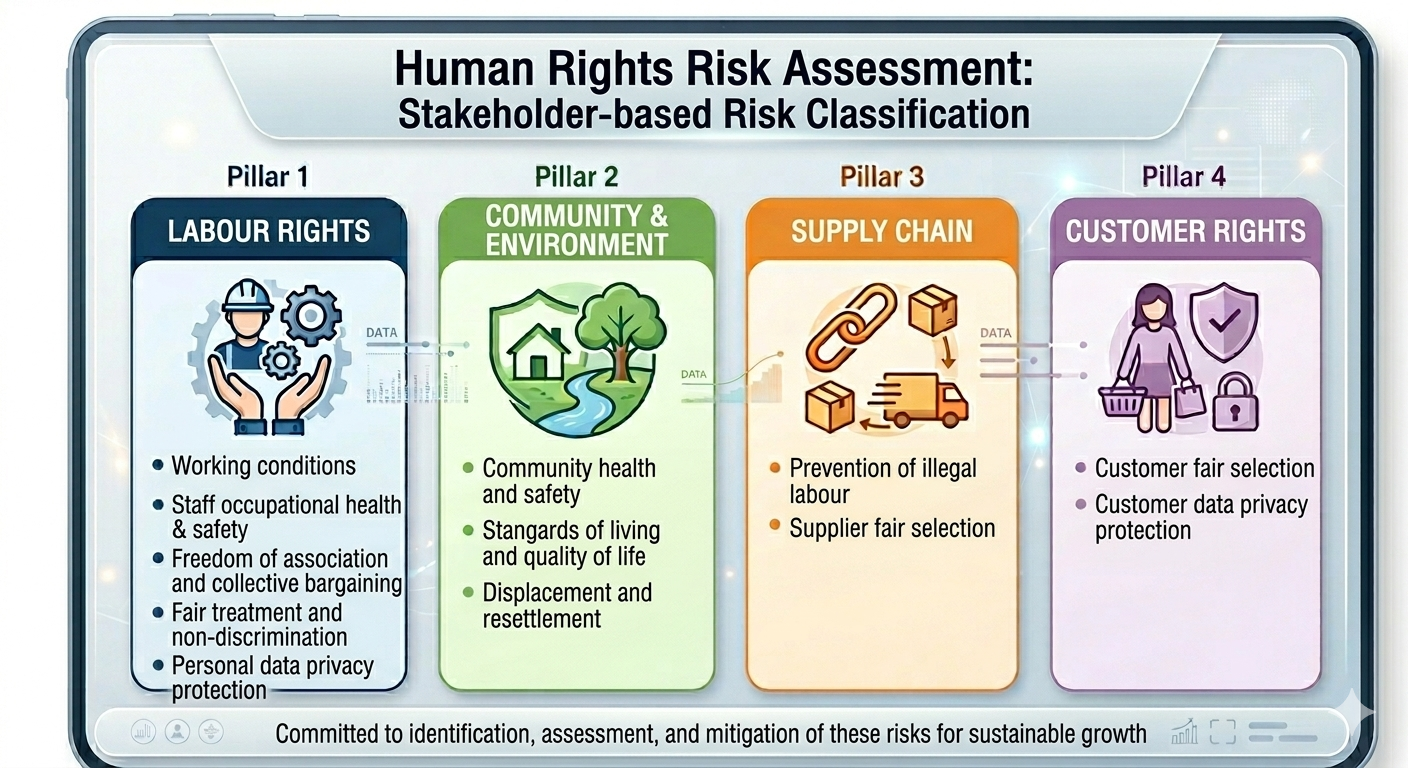
Human Rights Due Diligence (HRDD)
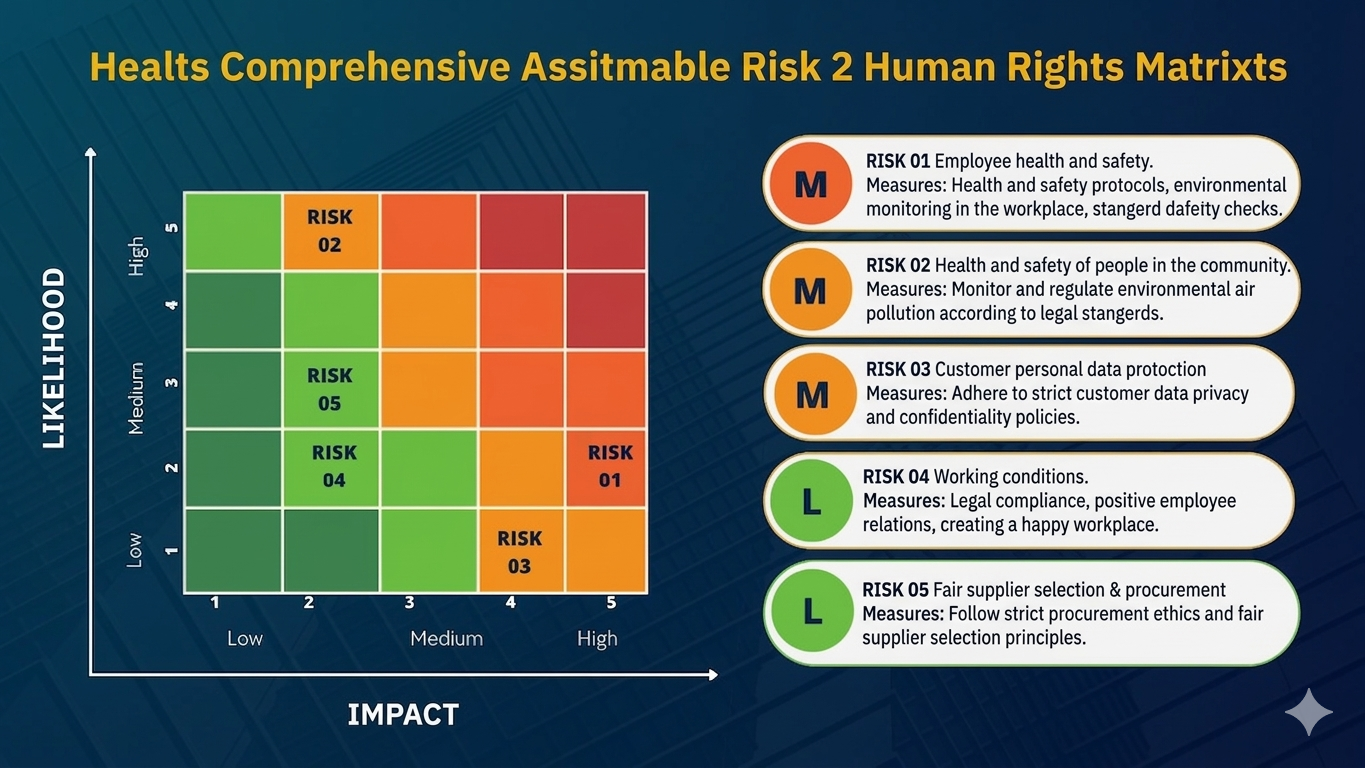
In 2025, the company had no cases or complaints regarding human rights violations. Therefore, there were no remedial measures and necessary corrective actions.
Employee Management — Overview
Introduction
The company recognizes the value of its employees and considers them to be the organization's most valuable resource. The company has adjusted its human resource management system in various ways to be more flexible in order to increase the organization's adaptability in terms of employment, employees, and working conditions. This is achieved by reviewing the current human resource management system, which serves as the basic structure and principles, and developing additional systems in various formats that can better meet the needs of each employee group.
Employees — Plan & Guidelines
Has an Employee Management Plan
Yes
Plan Description
Fair Compensation
The Company prioritizes the value of our employees, considering them the organization’s most precious resource. We have enhanced our Human Resource Management systems to be more flexible, increasing organizational adaptability regarding employment, staffing, and working conditions. This involves reviewing current fundamental structures and developing additional systems to better respond to the specific needs of diverse employee groups. Wage determination and benefits are managed fairly under corporate policies.
Employee Training and Development
"Developing Employees to Stand Above Artificial Intelligence" The Company is committed to proactively and systematically developing human resource capabilities based on individual potential and departmental needs. We aim to cultivate employees with modern knowledge and mindsets, vision, leadership, and management skills, while fostering integrity, ethics, determination, and positive social consciousness.
The Company has established a Personnel Development Plan under the 2020-2025 Strategic Development Framework and Competency-based Human Resource Development. This plan considers relevant environmental factors, including vision, mission, organizational culture, corporate strategy, personnel data, staff competencies, career path progression, and the competitive landscape of the automotive industry. This ensures that personnel development is concrete, clear, and systematically implemented.
Personnel Capability Development Strategy
The Company regards human resources as more valuable than all other administrative resources. Therefore, every employee will receive systematic and continuous training to develop knowledge, skills, attitudes, and efficient performance for career advancement. The Company reserves the right to consider training based on suitability.
Competency-based Development Framework
The Company categorizes competencies into three main groups:
Core Competency: Core capabilities that everyone in the company must share.
General Competency: General skills and knowledge, such as Law, Safety, Environment, and Customer Quality Requirements.
Functional Competency: Specific job-related capabilities that vary according to roles and responsibilities.
Beyond the competency framework, the Company emphasizes developing employee skills and welfare in all dimensions: Physical Health (promoting exercise), Financial Health (training on savings and investment), and a Positive Working Environment (restrooms, cafeterias, facilities). We promote a participatory culture through shared KPIs and technological advancement, including Upskilling in EV technology and Reskilling in AI and Automation to retain high-skilled personnel long-term.
Furthermore, the Company is shifting its work culture from Top-Down to Cross-Functional Integration, empowering employees at all levels to participate in thinking and decision-making. We believe that employee readiness—physically, mentally, and financially—leads to greater efficiency, responsibility, and engagement. This aligns with our core policies: Cost Cutting, Cost Culture & Open Mind, Continuous Improvement (Kaizen), and Responsibility (COLD: Care, Obedience, Loyalty, Disclose).
Promoting Employee Relations and Engagement
The Company implements multi-dimensional activities to strengthen workforce readiness and commitment:
Physical Health: Supporting exercise and healthcare to ensure energy and stamina, resulting in improved mental focus and work efficiency.
Financial Health: Providing training on savings and financial planning to reduce economic stress and absenteeism.
Workplace Environment: Upgrading restrooms, cafeterias, and buildings to be clean and safe, fostering happiness and organizational pride.
Participative Culture: Encouraging shared KPI tracking and an Open-Mind Culture to promote cross-functional integration, transparency, and collective responsibility.
Maintain High-Skill Staff: Prioritizing the retention of key talent by creating a culture of listening and team brainstorming, reducing turnover rates.
Migrant Workers
The Company has updated its Non-Discrimination Policy to cover migrant workers and various contract types. Every migrant worker receives equal opportunities for training and development, similar to local employees. We provide handbooks, forms, and signage in the migrant workers' native languages. Additionally, all business partners undergo training in sustainability, human rights, and non-discrimination, and must sign a commitment to the proper treatment of migrant workers.
Child Labor
The Company strictly complies with labor laws in Thailand and all countries where we operate. We prohibit illegal child labor and do not hire anyone under the age of 15. For employees under 18, we ensure they do not work more than 8 hours per day, do not work at night (22:00 – 06:00), and are prohibited from hazardous work or environments that impact their health, mental state, morals, or compulsory education. Partners in our value chain must also sign agreements to enforce minimum age requirements and prevent illegal child labor.
Occupational Health and Safety
The Company has set a goal of Zero Lost Time Injuries (LTI). We maintain an Occupational Health and Safety Management System that complies with legal requirements and safety policies. This includes improving working conditions, machinery, risk control measures, and providing safety training to prevent accidents and occupational diseases. We continuously monitor safety effectiveness and have added new indicators.
Plan Areas
| Plan Area |
|---|
| Fair employee compensation |
| Employee training and development |
| Promoting employee relations and participation |
| Migrant/foreign labor |
| Child labor |
| Occupational health and safety in workplace |
Employees — Workforce
Workforce Data
| Metric | Current Year | Previous Year | Two Years Ago |
|---|---|---|---|
| Total number of employees (Persons) | 1,716 | 1,908 | 2,096 |
| Number of male employees (Persons) | 1,229 | 1,374 | 1,430 |
| Number of female employees (Persons) | 487 | 534 | 666 |
| Total employment of disabled persons (people) | 18 | 20 | 21 |
| Total disabled employees (people) | 15 | 18 | 20 |
| Total male disabled employees (people) | 13 | 16 | 18 |
| Total female disabled employees (people) | 2 | 2 | 2 |
| Total disabled workers who are non-employee (people) | 3 | 2 | 1 |
| Contributions to the fund for promoting and improving the quality of life for disabled persons | 0 | 1 | 0 |
| Total number of male employees in operational level (Persons) | 1,179 | 1,327 | 1,382 |
| Total number of male employees in management level (Persons) | 41 | 41 | 41 |
| Total number of male employees in executive level (Persons) | 9 | 6 | 7 |
| Total number of female employees in operational level (Persons) | 465 | 511 | 642 |
| Total number of female employees in management level (Persons) | 21 | 23 | 24 |
| Total number of female employees in executive level (Persons) | 1 | 0 | 0 |
Employees — Remuneration & Provident Fund
Introduction
Compensation and Benefits Management Policy
The company values its employees and considers them to be the most valuable resource of the organization. The company has improved its human resource management system in various ways to be more flexible in order to enhance the organization's adaptability in terms of employment, employees, and working conditions by reviewing the current human resource management system, which is the structure or basic principles, and developing additional systems in various forms that can better meet the needs of each employee group. In determining compensation and benefits, the company has taken into account Equitably and fairly as the following factors:
1. Consistent with legal requirements.
2. Consistent with the general economic conditions of the country.
3. Competitive with the salary rates of other companies with a similar status to the company.
4. Responsibilities, positions, and levels of each employee.
5. The company's situation and necessity.
Employee Performance Evaluation Criteria
The company requires an annual performance evaluation for employees at all levels within the specified timeframe according to the policy, which may be changed as appropriate or as deemed appropriate by the company. The performance evaluation guidelines will be announced in advance each time.
1. Evaluation Score Level
Grade 1 means Improve or Unsatisfactory < 9 Points
Grade 2 means Fair or Needs Improvement 10 -12 Points
Grade 3 means Good or Standard 13 -15 Points
Grade 4 means Very Good or Above Standard 16 -18 Points
Grade 5 means Excellent or Much Higher Than Standard 19 -20 Points
2. Evaluation Criteria: Determining the weight of the evaluation. Divided into 3 topics as follows:
1. Work Performance
2. Work Behavior
3. Conduct
3. Applying job evaluation Considered and compared to be relevant to the performance of the job description according to the specified criteria.
4. Performance Evaluation and Job Evaluation It will be part of the consideration for annual salary adjustments and bonuses.
Remuneration & Provident Fund
| Metric | Current Year | Previous Year | Two Years Ago |
|---|---|---|---|
| Total disabled employees (people) | 543,087,444.87 | 583,981,421.91 | 653,511,375.37 |
| Total male employee remuneration (Baht) | 396,920,694.59 | 419,537,038.68 | 461,991,814.13 |
| Total female employee remuneration (Baht) | 146,166,750.28 | 164,444,383.23 | 191,519,561.24 |
| Number of employees eligible to participate in PVD (persons) | 1,299 | 1,717 | 1,856 |
| Total number of employees joining employee provident fund (Persons) | 747 | 900 | 871 |
| Percentage of total number of employees joining employee provident fund to total number of employees (%) | 43.53 | 47.17 | 41.56 |
| Number of PVD members / Total eligible employees (%) | 57.51 | 52.42 | 46.93 |
| Total amount of provident fund contributed by the Company (Baht) | 4,768,817.41 | 5,276,489.02 | 5,280,000 |
| Total amount of provident fund contributed by employee (baht) | 8,191,728.46 | 8,000,876.81 | 6,622,974.85 |
Employees — Training & Development
Introduction
Strategies for Human Capital Development
The company considers human resources to be the most valuable resource of all management resources. Therefore, all employees will be trained to have knowledge, skills, attitudes, and develop work efficiency systematically and continuously for career advancement. The company reserves the right to consider as appropriate.
Training and Development Guidelines
The Human Resources Department defines the curriculum and prepares an annual training plan, which consists of details of the training courses as follows:
1.1 Training Need is a course that is necessary to train employees.
(1) Law Course is a course that government agencies require to be trained or complied with in order to comply with the law.
(2) Company Policy Course is a course that the executives have assigned to be trained in order to be able to respond to the rapidly changing situation.
(3) Request by Customer Course is a course that customers want to be trained or complied with in order to be consistent with customer policies.
1.2 Training Request by Annual Survey is a training course to develop knowledge, abilities, and skills in work for employees.
(1) Function Course is a course on specific work skills for each department, job position, and career.
(2) Quality Course is a course related to the quality standard system, including courses related to various quality promotion activities.
(3) New Project Course is a training course to prepare employees for new jobs.
(4) General Course is a general course that needs to be trained, reviewed, or arises from the results of an internal quality system audit (Internal Audit Result) or arises from problems or results of work (KPI) or others as appropriate.
Sending personnel for training with external training institutions
The company has the Human Resources Department contact and gather information about training courses organized by various external institutions that will be beneficial to the work and development of employees' potential, which is prepared as an annual training plan. The selection of external institutions must be transparent.
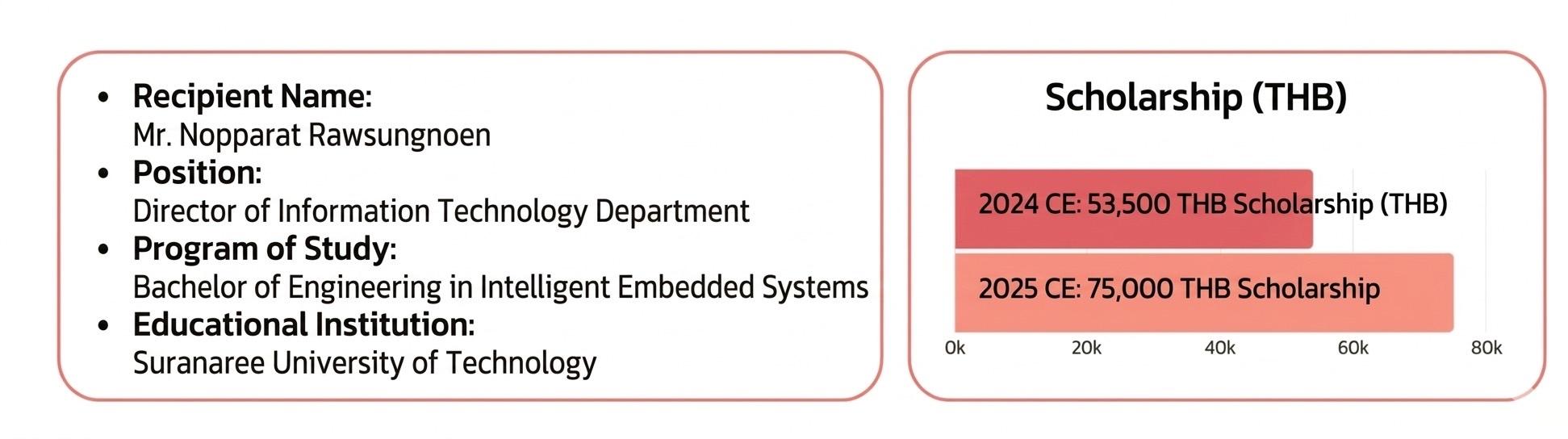
Providing scholarships and study tours
The Human Resources Department will coordinate the company's scholarships to employees who work for the company for further education, educational qualifications adjustment, mandatory level or position adjustment, and continuous enhancement of personnel quality, including study tours both domestically and internationally as needed by the department, as well as the company's business trends and directions.
Business Excellence Scholarship Program for Employees' Children and the General Public
In 2022, the Nomination and Remuneration Committee approved the criteria for the "Business Excellence Scholarship Program," with the following objectives:
To support and provide educational opportunities for employees or the general public who possess high potential and capability but lack financial resources, enabling them to pursue studies in fields that can directly contribute to the company’s development.
To encourage participation in and strengthen the company’s organizational growth.
To support and align with the company’s Sustainable Development Goals (SDGs).
The selection process for the program will commence in the 2024 academic year, with one undergraduate scholarship awarded to an employee participating in the program.
2025 Training and Development Summary
Training Course Category | Number of Courses | Number of Participants |
Orientation | 32 | 225 |
Environmental Awareness | 12 | 310 |
Occupational Health and Safety | 41 | 973 |
Quality Management System (QMS) | 18 | 836 |
Human Resource Development | 6 | 44 |
Job Skill Development / Upskilling | 16 | 171 |
Total | 125 | 2,559 |
Training Data
| Metric | Current Year | Previous Year | Two Years Ago |
|---|---|---|---|
| Average employee training hours (Hours / Person / Year) | 20 | 22 | 30 |
| Employee development and training expenses (baht) | 326,367 | 109,821 | 0 |
Employees — Occupational Health & Safety
Introduction
P.C.S. Machine Group Holding Public Company Limited is committed to conducting business with a strong focus on occupational health, safety, and the working environment. The Company supports personnel and activities aimed at enhancing quality in safety, health, and environment, while maintaining a safe working atmosphere across all areas to protect the lives, physical well-being, and property of employees and stakeholders. Therefore, the Company hereby announces its Occupational Health, Safety, and Working Environment Policy as an operational guideline as follows:
The Company shall implement and develop an occupational health, safety, and working environment management system suitable for the organization, complying at a minimum with laws, obligations, and other requirements agreed upon by the organization for both employees and stakeholders.
The Company shall provide adequate and appropriate resources, including personnel, time, budget, and training, to raise awareness and foster participation in developing the occupational health, safety, and working environment management system according to standards.
The Company shall support policies for identifying, analyzing, and evaluating risks and opportunities to prevent and improve upon causes of accidents, disasters, life-threatening hazards, work-related illnesses, and off-the-job safety issues that impact the life, body, and property of employees and stakeholders. Risk assessment results at a moderate level or higher will be used to define annual occupational health, safety, and working environment objectives and targets. With a goal of "Zero Accidents" both on and off the job, these targets shall be communicated to all relevant parties to ensure the creation of a positive safety culture and continuous, sustainable development.
The Company encourages all employees to participate in accident prevention and welcomes suggestions/opinions from employees for consideration and risk improvement to ensure maximum safety. This is regarded as the responsibility of management, and all employees are required to comply strictly.
Safety Targets for 2025:
Fatalities and Major Injuries (Permanent Disability) = 0 Cases
Other Accidents = 50% reduction compared to 2024
Occupational Health & Safety Data
| Metric | Current Year | Previous Year | Two Years Ago |
|---|---|---|---|
| Total number of lost time injury incidents by employees (Cases) | 3 | 6 | 10 |
Employees — Labour Relations
Introduction
Labor Relations Policy
(1) The company supports and creates a happy working environment.
(2) The company strives to resolve any conflicts that arise through peaceful means.
(3) The company always takes care of employees in various matters fairly and appropriately according to their level of responsibility without the need for employees to request.
(4) Regularly organize activities and communicate messages to employees to build good relationships between the company and employees, and among employees themselves.
(5) If there are any changes in work regulations that will affect employees, the company will discuss or resolve them by obtaining approval from the affected employees.
Labour Relations Data
| Metric | Current Year | Previous Year | Two Years Ago |
|---|---|---|---|
| Total voluntary resignations (Persons) | 287 | 369 | 273 |
| Male employees who voluntary resigned (Persons) | 219 | 229 | 193 |
| Female employees who voluntary resigned (Persons) | 68 | 140 | 80 |
| Percentage of employee turnover leaving the Company voluntarily (%) | 16.72 | 19.34 | 13.02 |
| Evaluation result of employee engagement | 1 | 1 | 1 |
Employees — Employee Representation
Introduction
Freedom of expression and association of employees to improve the quality of working life.
The company has established channels for employees to express their opinions, including the establishment of a Welfare Committee in the workplace to listen to and gather suggestions. These suggestions are then presented to the executives and relevant departments to improve and develop the quality of life in both labor and human rights aspects. This is achieved through various channels such as happiness and opinion surveys, and employees can also express their opinions through complaint boxes provided in each factory, etc.
The Welfare Committee in the workplace has the following powers and duties:
1. Consult with employers to provide welfare to employees.
2. Provide advice and suggestions to employers in providing welfare for employees.
3. Inspect, control, and supervise the welfare provided by employers to employees.
4. Propose opinions and guidelines for providing beneficial welfare to employees to the Labor Welfare Committee.
Employees Are Represented Collectively
Yes
Forms of Representation
| Form |
|---|
| Welfare committee |
Employees — Targets
Has Set Employee Targets
Yes
Targets
| Indicator | Target Areas | Base Year | Base Year — Description | Target Year | Target Year — Description |
|---|---|---|---|---|---|
| 20 hours of employee training per person per year | 2983 · Description: Fair employee compensation | 2,023 | Every employee undergoes performance appraisal and receives fair compensation in accordance with legal requirements | 2,025 | 100% |
| Average training hours: 20 hours per person per year | 2984 · Description: Employee training and development | 2,025 | 20 hours per person per year | ||
| Engaging in physical health and wellness promotion programs 100% | 2985 · Description: Promoting employee relations and participation | - | 2,025 | 100% | |
| Migrant workers receive welfare benefits, as well as learning and development opportunities, equal to those of local employees | 2986 · Description: Migrant/foreign labor | - | 2,025 | 100% | |
| No illegal child labor is employed within our operations. | 2987 · Description: Child labor | - | 2,025 | 100% | |
| Zero accident | 2988 · Description: Safety and occupational health at work | - | 2,025 | 3 Accidents |
Employees — Performance & Outcomes
Has Performance Results
Yes
Performance Description
Employee Well-being and Labor Relations
Physical Health Promotion
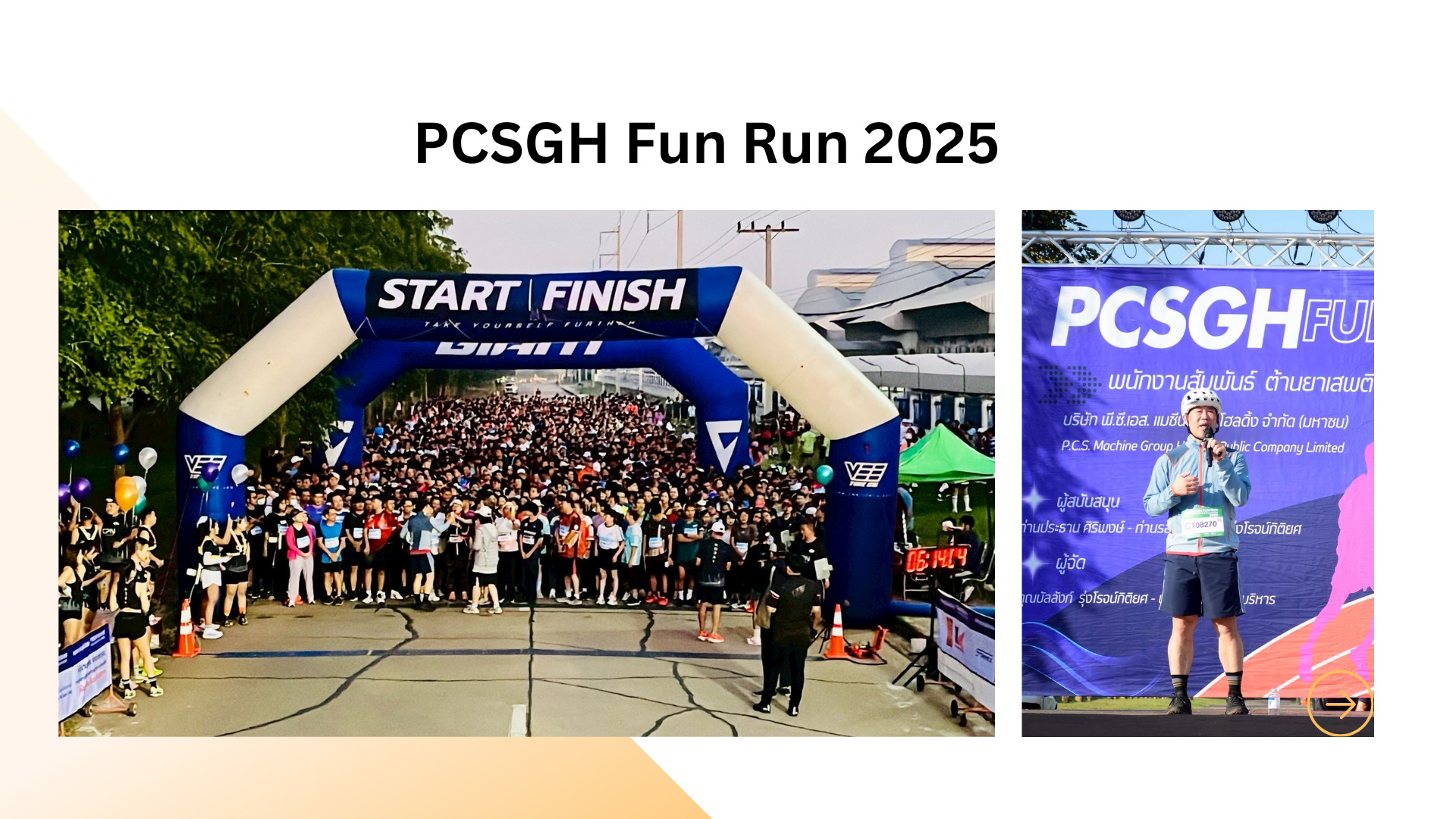
In 2025, the Company actively promoted physical activities and healthcare initiatives to ensure employees maintain high energy levels and sustained work performance. These initiatives enhance both physical and mental well-being, leading to improved concentration and operational efficiency. On December 20, 2025, the Company organized the "PCSGH FUN RUN 2025," a 7-kilometer run held at the golf course and the P.C.S. Estate Industrial Zone. The event saw 100% participation from our employees, alongside staff from subsidiary companies, totaling over 2,200 participants.
The Company also invited key stakeholders, local communities, and government agencies to join the event, while promoting the project through local media outlets. This successful event was made possible through the great cooperation of management and employees, as well as over 20 sponsors from banks and local businesses. All sponsorships were conducted with full transparency, adhering to Good Corporate Governance and Anti-Corruption Policies, and have been verified by internal auditors.
Additionally, the Company provided meal boxes to Theparat Nakhon Ratchasima Hospital in appreciation of their medical support and care for our employees throughout the event.
Office Syndrome Prevention
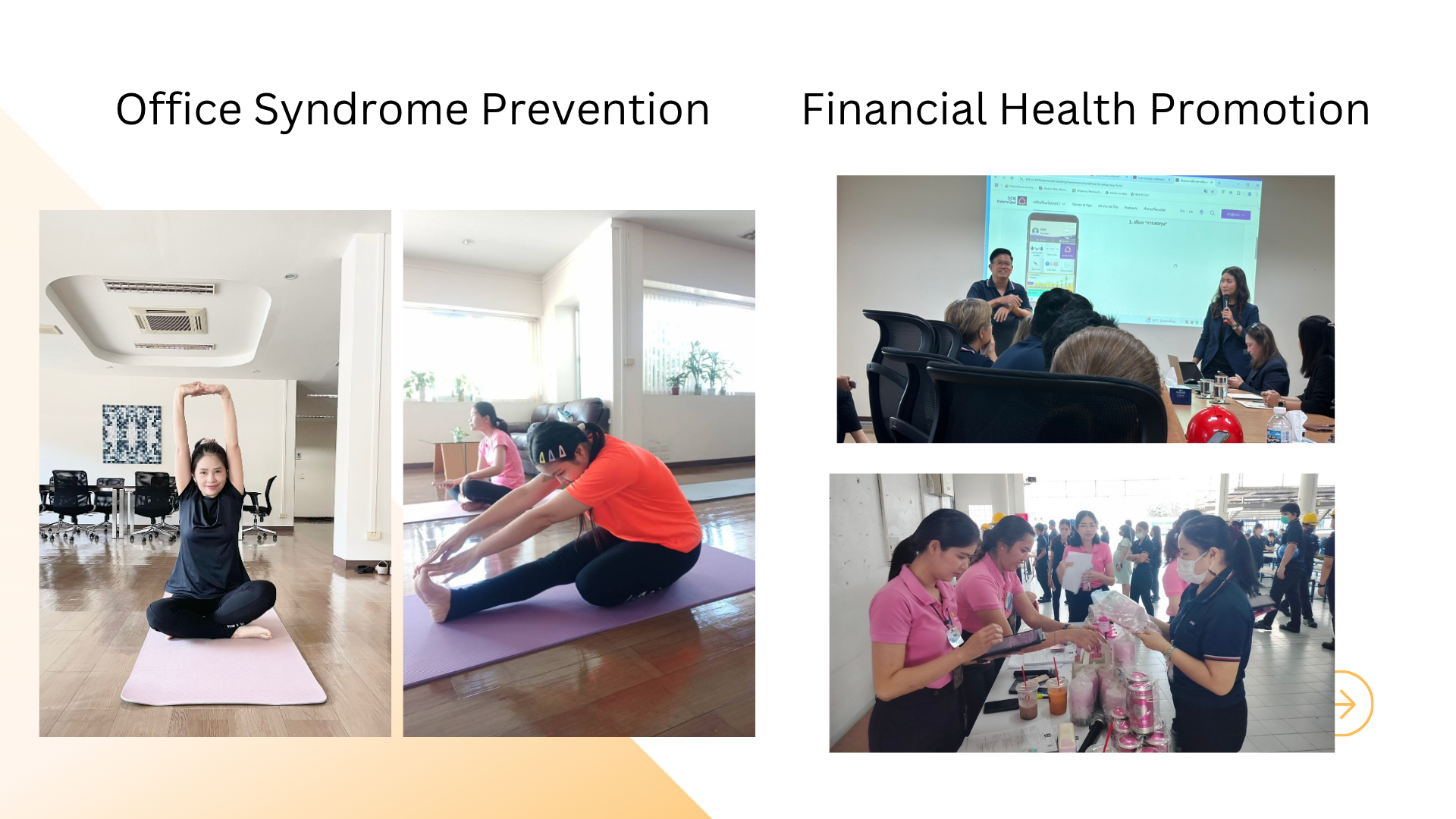
The Company supports health promotion activities specifically designed for office-based employees to prevent Office Syndrome. This condition, characterized by myofascial pain, tendon inflammation, and numbness caused by repetitive movements or prolonged static posture, is common among office workers using computers or mobile devices. Left untreated, chronic pain in the neck, shoulders, back, and wrists can impact long-term quality of life. To address this, the Company hosts Yoga sessions every Saturday to encourage muscle relief and long-term health.
Financial Health Promotion
Recognizing that financial stability reduces stress and improves attendance, the Company organized financial literacy training focusing on savings, investment, and financial planning. We invited Siam Commercial Bank (SCB) to provide expert knowledge to interested employees.
Furthermore, the Company has enhanced the Provident Fund (PVD) management options, allowing employees to personally select investment plans based on their risk appetite:
100% Fixed Income Investment
Customized Portfolio Selection across various risk levels, including:
Money Market/Short-term Fixed Income: PVDMPFMM, PVDSFFPI
General Fixed Income: PVDMPFFI
Equity: PVDMEQDV (Dividend), PVDMEQSE (Select Equity)
International/Global Funds: PVDMFLEQ
Gold Fund: PVDMGLDH (capped at 10%)
Achievement and Recognition
As a result of our comprehensive labor management practices, the Company was honored with the "Thailand Outstanding Establishment Award for Labor Relations and Welfare 2025." This marks the 10th consecutive year the Company has received this prestigious national recognition.
Customer Management — Overview
Introduction
Customer Policy and Practices
The company recognizes the importance of customers and has established the following customer service policy:
• Serve customers with courtesy, enthusiasm, and sincerity, providing prompt, accurate, and reliable services.
• Maintain customer confidentiality and refrain from using it for personal gain or for the benefit of related parties without authorization.
• Provide customers with accurate, adequate, and up-to-date information about the services without exaggeration that may lead to misunderstandings about the quality or any conditions of the company's services.
• Provide advice on how to use the company's services effectively and to the customers' utmost benefit.
Customers — Plan & Guidelines
Has a Customer Management Plan
Yes
Plan Description
Customer Management
We focus on quality control, production standards, and maintaining customer relationships.
Quality Control and Production Standards
a. Production Standards : We adhere to a strict quality management system to ensure that our products are of the highest quality and safety.
b. Inspection and Testing: Rigorous inspection and testing are carried out throughout the production process to maintain product quality and consistency.
c. Supplier Quality Management : We work closely with our suppliers to ensure that the materials and parts used in our manufacturing meet our stringent quality standards.
f. Building Quality Awareness : We promote a culture of quality within the organization by educating employees about the importance of their role in maintaining product quality and customer satisfaction.
Customer Relationship Management
a. Customer Satisfaction Our goal is to deliver quality work and services that are recognized by international standards. We, therefore, place importance on participating in various activities consistently, from acknowledging customer policies in various aspects, collaborating in design, and developing production processes to obtain quality and safe products. We also consider the use of raw materials and processes that reduce environmental impact at competitive costs.
b. Customer Confidentiality To build trust and confidence in conducting business, we are committed to complying with established data security laws and standards.
3. Maintaining customer personal information
The company has a policy of strictly maintaining the confidentiality of company information, customer information, or information related to any business that the company does not disclose. This is to provide guidelines for managing confidential information to have standards for care and effective management. It also aims to raise awareness of confidential information protection and lead to the prevention of confidential information leakage.
All parties must respect the confidentiality related to the company's intellectual property, including trade secrets. The company reserves the right to take legal action to exercise its rights to the fullest extent if it is found that any person misuses the information or seeks benefits from the company's assets and trade information.
Confidentiality Policy
Practices
1. Must strictly maintain the confidentiality of confidential information of the company, customers, or related to any business that the company does not disclose.
2. Must not disclose any information relating to the business, finance, and personnel of the company. It is important to act in accordance with the correct and appropriate guidelines that have been authorized. This must be done with caution and effectiveness.
3. Must maintain the confidentiality of the company and not use it for the benefit of oneself or related parties improperly throughout the period of being an employee of the company. The obligation of non-disclosure must continue indefinitely, even if the employee retires, is transferred, resigns, and all confidential information is returned. After the termination of employment, this confidential information must still be kept confidential.
4. If such information is disclosed, given to others, or used for any other purpose than performing duties for the company and causes damage to the company or causes the company to lose any benefits, the discloser agrees to be liable for and compensate the company for the actual damages. All executives, employees, and contractors of the company must be aware of the data security procedures and comply with them to prevent unintentional disclosure of confidential information.
Plan Areas
| Plan Area |
|---|
| Responsible production and services for customers |
| Development of customer satisfaction and customer relationship |
| Protection of customer personal information |
Customers — Satisfaction Results
Customer Satisfaction Results
| Metric | Current Year | Previous Year | Two Years Ago |
|---|---|---|---|
| Evaluation results of customer satisfaction | 1 | 1 | 1 |
Customers — Targets
Introduction
The company considers responding to customer needs as the heart of business development. We consistently exchange and participate in various customer activities, from understanding customer policies in various aspects to designing and developing production processes to obtain quality and safe products. We consider using raw materials and processes that reduce environmental impacts with competitive costs to create customer satisfaction. Because the goal is to deliver quality work and services that are accepted according to international standards, the company has a policy of systematic management. We open opportunities for customer representatives to meet with employees and provide privileges to employees, organize car shows to promote sales, and stimulate purchases of vehicle groups that the company participates in producing.
Has Set Customer Targets
Yes
Targets
| Indicator | Target Areas | Base Year | Base Year — Description | Target Year | Target Year — Description |
|---|---|---|---|---|---|
| Customer satisfaction development and relationship building | 3009 · Description: Development of customer satisfaction and customer relationship | 2,023 | 85 percent | 2,026 | 95 percent |
Customers — Performance & Outcomes
Has Performance Results
Yes
Performance Description
Participation in various events organized by customers.
The company has a policy to strictly maintain the confidentiality of company information, customer information, or information related to any business that the company does not disclose. This is to provide guidelines for managing confidential information to have standards for efficient care and management, and to raise awareness in confidential information protection, leading to the prevention of confidential information leakage.
The average customer satisfaction assessment result in 2025 is 91.89 percent, which meets the target.
Community & Social — Overview
Introduction
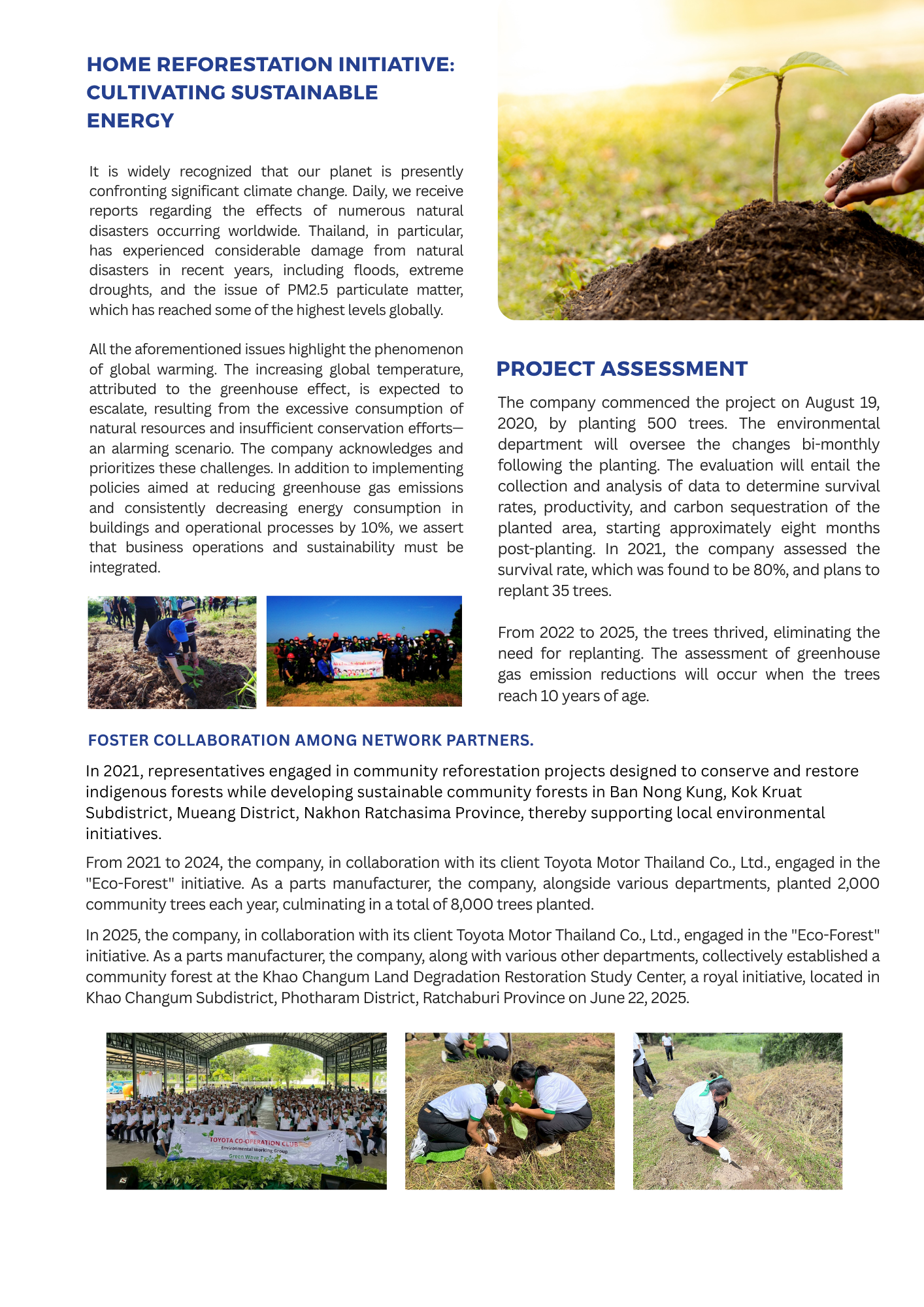
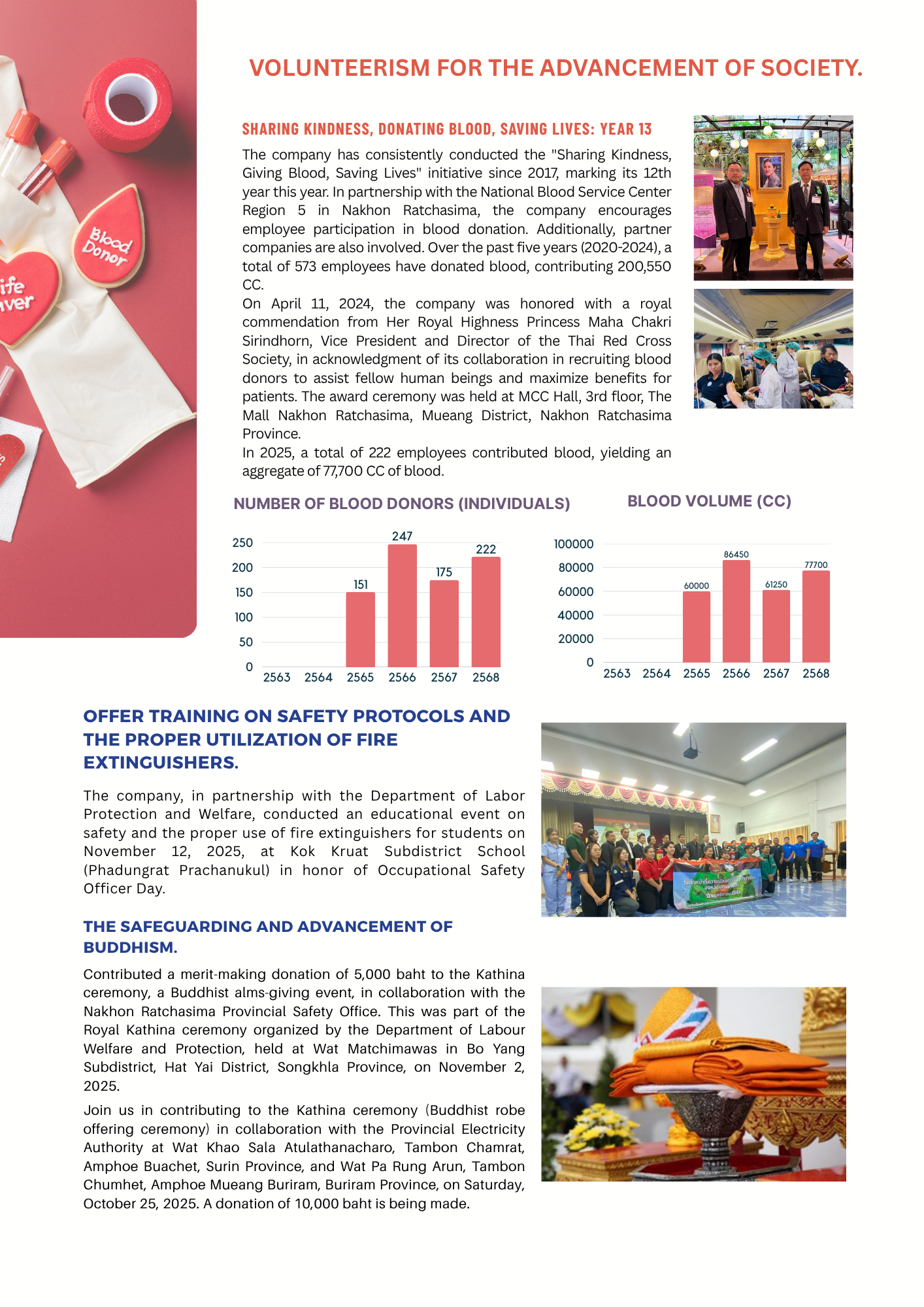
The company is committed to "Creating Opportunities for Society to Grow Together Sustainably" to promote sustainable development by responding to the needs of the community and society. The company has defined a strategy for social and community investment to be in line with the organization's business strategy, budget, and the needs of the community. There is a key policy to encourage employees to have volunteerism and teamwork, working together in various activities both inside and outside the organization through the goal of shared good hours throughout the organization.
Community & Social — Plan & Guidelines
Has a Community & Social Plan
Yes
Plan Description
In addition, the company also provides opportunities for employees to propose various projects related to the development of communities, society, or the employees' hometowns. Apart from promoting good deeds among all employees within the organization, the company focuses on building networks with educational institutions to benefit the organization's operations and the institutions themselves. This is particularly evident in the development of professional standards in skills and expertise specific to the automotive industry, and in developing students to enter the automotive workforce. This supports the need for personnel and critical skills, and contributes to the Sustainable Development Goals (SDGs) of creating equitable education and promoting innovation within the industrial sector.
Plan Areas
| Plan Area |
|---|
| Employment and professional skill development |
| Education |
| Religion and culture |
| Forests and natural resources |
| Sports and recreation |
| Occupational health, safety, health, and quality of life |
| Reducing inequality and promoting social equality |
Community & Social — Targets
Has Set Community & Social Targets
Yes
Targets
| Indicator | Target Areas | Base Year | Base Year — Description | Target Year | Target Year — Description |
|---|---|---|---|---|---|
| Participation Frequency ≥ 1 Time/Year | 3041 · Description: Occupational health, safety, health, and quality of life | 2,025 | - | 2,025 | 1. Activity 2 Time/Year
2. Participation Frequency ≥ 1 Time/Year |
| Local Recruitment and Community Employment | 3036 · Description: Employment and professional skill development | 2,025 | Local Hiring Ratio ≥ 80% | 2,025 | 90% |
| Educational Opportunities | 3037 · Description: Education | 2,025 | - | 2,025 | 100% |
| Contributing to the preservation and promotion of Buddhism 1 Time/Year | 3038 · Description: Religion and culture | - | 2,025 | 100% | |
| Participating in reforestation and natural resource conservation activities with the community at least once a year. | 3039 · Description: Forests and natural resources | - | 2,025 | 100% | |
| Stakeholder participation in company sports and recreational activities. 1 Time/Year | 3040 · Description: Sports and recreation | 2,025 | 2,025 | 100% |
Community & Social — Performance & Outcomes
Has Performance Results
Yes
Performance Description
Law Violation Incidents
Law Violation Incidents
| Metric | Current Year | Previous Year | Two Years Ago |
|---|---|---|---|
| The total number of cases or incidents of significant violations of laws or regulations regarding social and human rights (Cases) | 0 | 0 | 0 |
| The total number of cases or incidents that cause significant labor disputes (Cases) | 0 | 0 | 0 |
| The total number of cases or complaints related to consumer rights violations (Cases) | 0 | 0 | 0 |
| The total number of cases or complaints related to partner rights violations (Cases) | 0 | 0 | 0 |
| The total number of cases or incidents that cause disputes with the community/society (Cases) | 0 | 0 | 0 |
| The total number of cases or incidents related to cyber security or customer data breaches (Cases) | 0 | 0 | 0 |
| The total number of cases or incidents related to safety and occupational health at work (Cases) | 0 | 0 | 0 |
Law Violations — Case Detail & Corrective Measures
Introduction
N/A